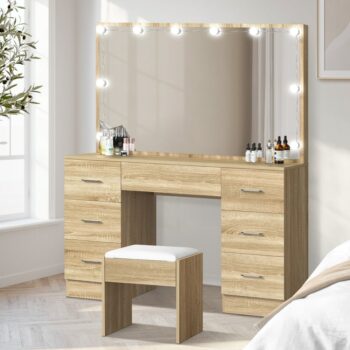
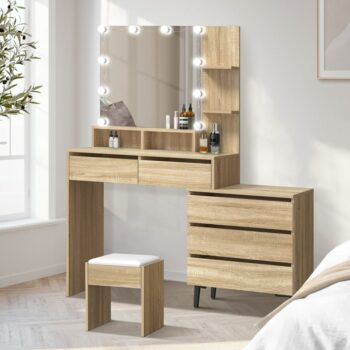
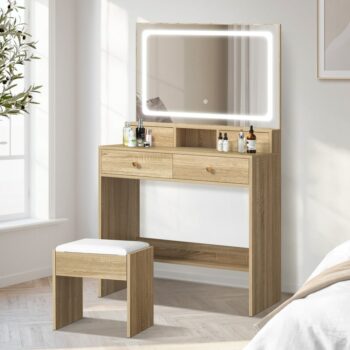
A dressing table works best when it fits both your room and your daily routine. Before choosing a finish, check where you will sit, how the drawers open and whether the mirror will be useful at your seated height.
This dressing table buying guide covers the practical details to compare in our dressing tables collection. Mirrors, stools and lighting vary between models.
Check the complete assembled width, depth and height, including the mirror and any side shelves. Mark the footprint on the floor and compare it with nearby doors, wardrobes and the bed.
Allow room to pull the stool or chair out and sit down comfortably. A table that fits against a wall may still block a walkway once someone is using it.
Check drawer extensions and opening doors separately. Corner tables, sliding mirrors and lift-up compartments need clearance for their full movement.
Compare seat height with the height beneath the desktop, including any drawer or support rail. Overall table height alone does not tell you how much legroom is available.
If keeping your own chair, measure its width and any armrests to see whether it can tuck underneath. Check whether the legs or storage pedestals narrow the usable opening.
For an included stool, read its dimensions and stated capacity. A padded seat does not automatically adjust in height, and a photograph of a stool does not confirm that one is supplied.
List what you need to store: bottles, brushes, makeup, jewellery or hair accessories. Tall bottles may need an open shelf or cupboard rather than a shallow drawer.
Compare internal measurements where available. The number of drawers is less useful than whether their usable space suits your belongings.
Keep enough desktop area for the items you use while seated. Follow the stated shelf, drawer and surface load limits, and check whether organisers or dividers are included.
Consider mirror position from your seated eye level. Check whether the mirror tilts, slides or stays fixed, and whether nearby windows could create distracting glare.
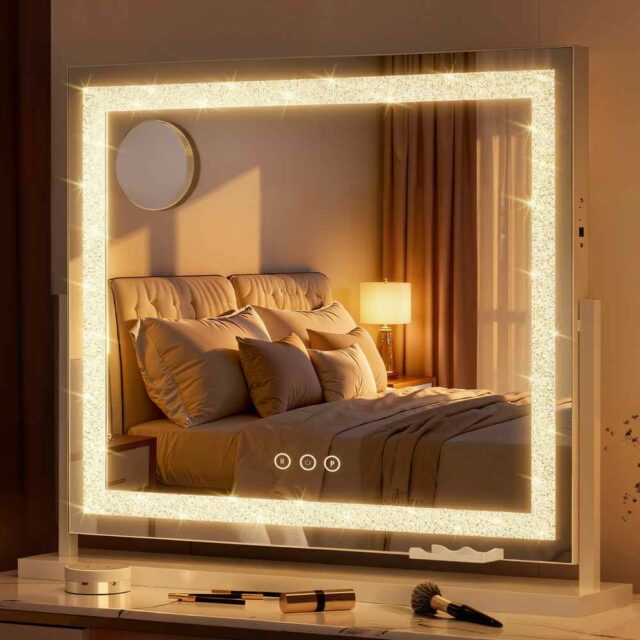
For illuminated models, confirm brightness adjustment, light settings and the power source. A product described as LED does not automatically include dimming, multiple colour temperatures or a charging port.
Read the package contents for the mirror, lights, cables and adaptor. If choosing a separate mirror, compare its base footprint and mounting requirements with the table. Browse our vanity mirrors for options to compare.
Check the stated construction and care instructions. Timber-look finishes, engineered wood and solid timber are different materials; photographs may not reveal what sits beneath the surface.
Read the assembly instructions and install the specified supports and mirror fixings. Anchor furniture to reduce toppling risk, using the manufacturer’s instructions and fixings suitable for your wall. Keep children from climbing on stools or drawers.
For more information, see the ACCC’s toppling furniture advice. Route electrical cables so they are not trapped in moving parts or stretched across a walkway.
Compare our dressing tables, review the delivery policy, or contact us before ordering if a measurement needs clarification.